
Zerubbabel’s signet ring is one of the most hopeful pictures of God’s grace in the Bible.
The foundation was already laid. That’s what hurts.
Years before, God’s people had come home from Babylon. They were full of hope. They put the first stones of God’s house in the ground. Some shouted for joy. Some cried out loud. Then enemies fought against them, and the work stopped. It stayed stopped. Year after year, the stones sat there. Nothing was built on top of them.
Now picture a man named Zerubbabel. He is the leader of Judah. A leader like him is called a governor. Every day he walks past that unfinished house. He walks past his neighbors’ homes too. Many of those homes now have fine wood on the walls.
The people around him have an answer ready: “The time has not come, the time that the Lord’s house should be built” (Haggai 1:2).
That means, not now. Maybe later.
Then, on the first day of the sixth month, a word from God comes through the prophet Haggai. It comes to Zerubbabel by name. “Zerubbabel the son of Shealtiel, governor of Judah” (Haggai 1:1).
What will he do with it?
That one question holds this whole article. What he did with God’s word led to the last thing God says in the book: “I have chosen you” (Haggai 2:23).
A ring that was pulled off
To feel what God says in Haggai 2:23, we have to go back to a hard day in Zerubbabel’s family.
His grandfather was Jeconiah. He is also called Coniah. He was a king of Judah. God spoke about him through the prophet Jeremiah, and the words were heavy. Even if this king were the signet on God’s right hand, the Lord said, “yet I would pluck you off” (Jeremiah 22:24).
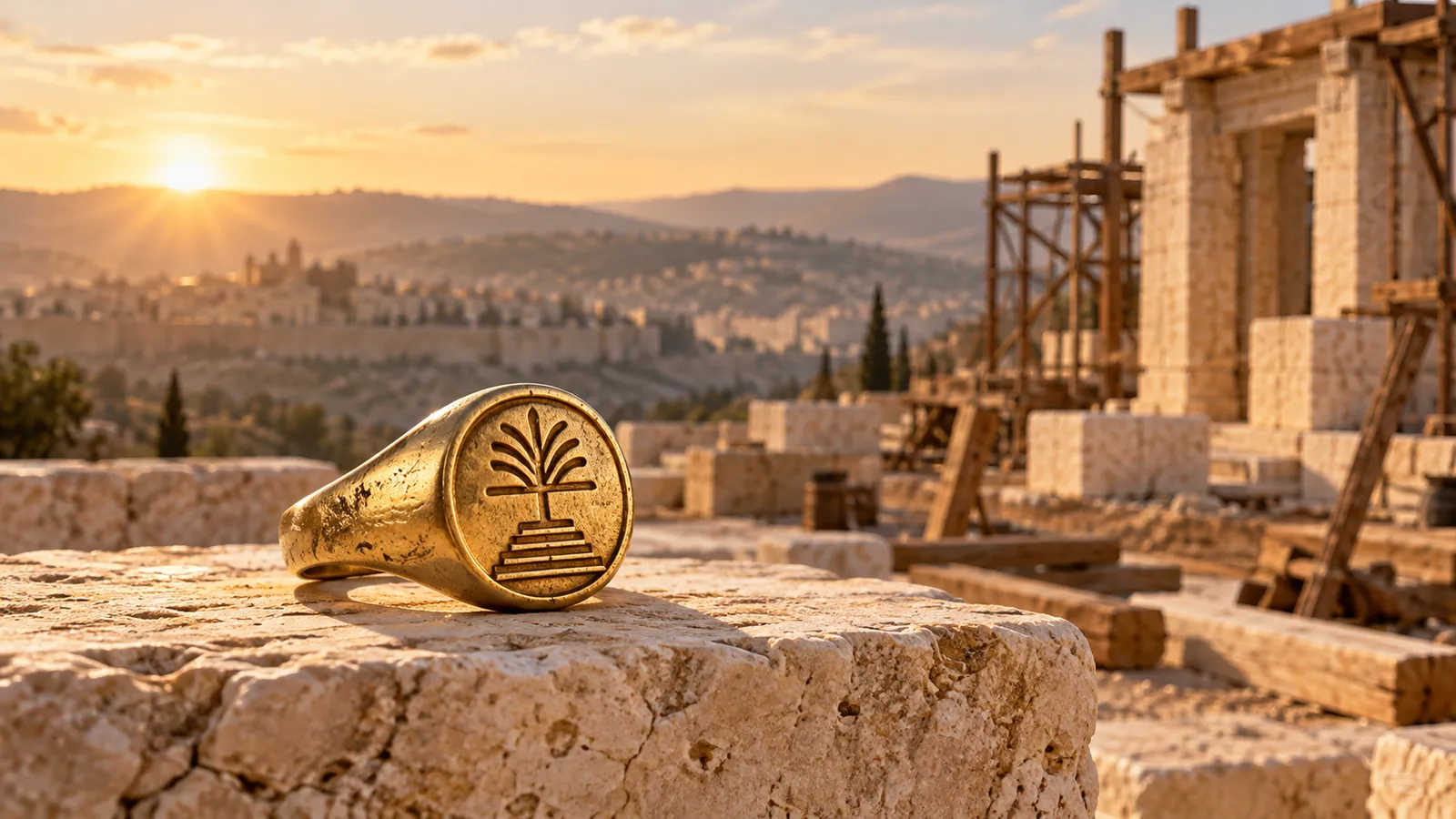
Read that slowly. A signet ring was a special ring with a seal on it. A person pressed it into soft wax, and the wax showed their power. Wherever the ring went, their power went too. God said He would pull that ring off Jeconiah’s hand.
Then the line of kings fell. Babylon took the people away. The family of David was left with a name and a broken story.
Now see who Matthew says came next. “Jeconiah begot Shealtiel, and Shealtiel begot Zerubbabel” (Matthew 1:12). Begot means was the father of.
So here is Zerubbabel. He is the grandson of the man whose ring was taken. He carries that family name every day. He is a governor, but he is not a king. Not yet. Not on his own.
And then the Lord looks at him and says something no one expects. This is about five hundred years before Jesus is born.
The ring put back on
Here are the last words of the book of Haggai. Take your time with them.
“‘In that day,’ says the LORD of hosts, ‘I will take you, Zerubbabel My servant, the son of Shealtiel,’ says the LORD, ‘and will make you like a signet ring; for I have chosen you,’ says the LORD of hosts.” (Haggai 2:23)
Read it again. Who is doing the work in that verse? I will take you. I will make you. I have chosen you. God is the one acting.
The ring that was pulled off Jeconiah’s hand is put back on the hand of his grandson. Judgment was not the last word for this family. Mercy was. Mercy means kindness we do not deserve. And look at what comes just before it. God says He will shake the heavens and the earth. He will knock down the thrones of kings (Haggai 2:21 to 22). In the middle of that great shaking, one man is safe. One man wears the seal.
A signet ring means someone trusts you with their power. Pharaoh “took his signet ring off his hand and put it on Joseph’s hand” (Genesis 41:42). When the ring moved, the power moved with it. God was telling Zerubbabel that He was putting His own power in this man’s hands.
He is also called “My servant.” Hold on to that word. We will come back to it.
So was this a reward? Did Zerubbabel earn it? No. His grandfather’s failure was still in the family. This was grace, a gift he did not deserve and could not buy.
But look closer at the road that led to the ring. A gift has to be received. A hand has to open. The Bible shows us where grace flows, and Zerubbabel stood in every one of those places.
There are eight of them.
Eight places where grace flows
1. Humility
“God resists the proud, but gives grace to the humble” (James 4:6). Resists means stands against.
Zerubbabel was the governor. He had power, a title, and a seat. A man like that could have waved off a prophet. He did not. He and Joshua, the high priest, and the whole remnant, which means the people who had come back, “obeyed the voice of the LORD their God, and the words of Haggai the prophet” (Haggai 1:12). A governor listened to a messenger, and he did not argue. That is what a humble heart looks like.
2. Faith
“Through whom also we have access by faith into this grace in which we stand” (Romans 5:2). Access means a way in.
The new house did not look like much. Some of the old men remembered the first house, and God asked them, “In comparison with it, is this not in your eyes as nothing?” (Haggai 2:3). Then He spoke straight to Zerubbabel: “Yet now be strong, Zerubbabel,” and later in the same verse, “I am with you” (Haggai 2:4). He had nothing to see yet. He had a promise. He built on it. Faith is just that: doing what God said before you can see it.
3. The Word of His grace
“I commend you to God and to the word of His grace, which is able to build you up” (Acts 20:32).
The word of the Lord came to Zerubbabel again and again. It came in Haggai 1:1, in 2:2, and in 2:21. He did not treat it like news to enjoy and forget. He treated it like an order to carry out. Some people hear the Word. Others receive it. The difference is what their hands do afterward.
4. The Spirit of grace
Hebrews 10:29 calls Him “the Spirit of grace.”
Look at Haggai 1:14. “The LORD stirred up the spirit of Zerubbabel.” God did the stirring. Zerubbabel did the yielding. Yielding means saying yes. Then the next words say they “came and worked on the house of the LORD of hosts.” And in 2:5, God adds, “My Spirit remains among you; do not fear.” The Spirit moves, and the one who says yes is carried along. A hard heart can feel the same stir and push it away.
5. The throne of grace
“Let us therefore come boldly to the throne of grace, that we may obtain mercy and find grace to help in time of need” (Hebrews 4:16). Boldly means without fear.
Prayer is not just a routine. It is fellowship with God, which means being close to Him. It is showing up in His presence, and sometimes it is turning around.
Haggai does not write down a prayer from Zerubbabel’s lips. It shows us something else. God says, “Consider your ways!” (Haggai 1:5). That means, think about how you are living. The very next thing we read is that Zerubbabel and the people obeyed. That is what turning around looks like. Then the people “feared the presence of the LORD” (Haggai 1:12). They came close, with deep respect. And God met them with the sweetest words in the chapter: “I am with you” (Haggai 1:13).
That is the throne of grace. You show up. You turn. And He says, I am with you.
6. Fellowshipping with God’s people
“And great grace was upon them all” (Acts 4:33).
Zerubbabel never stood alone in this book. Look at how often the names go together. Zerubbabel and Joshua and “all the remnant of the people” obeyed together (Haggai 1:12). The Lord stirred up all of their spirits (Haggai 1:14). When God sent a word in 2:2, He sent it to the governor, the high priest, and the people all at once.
Grace rests on people who come together more than it rests on a man who walks off alone. If you are hurting, don’t hide from the very people God is using to carry you.
7. Giving
“And God is able to make all grace abound toward you” (2 Corinthians 9:8). Abound means overflow.
The grace of God was even “bestowed on the churches of Macedonia” through their giving (2 Corinthians 8:1). Bestowed means given.
In Haggai, God asks a sharp question. “Is it time for you yourselves to dwell in your paneled houses, and this temple to lie in ruins?” (Haggai 1:4). Paneled means the walls were covered with fine wood. The people had been pouring everything into their own homes. God called them to “bring wood and build the house” (Haggai 1:8).
Haggai does not tell us how big Zerubbabel’s own gift was. It tells us where his time, his strength, and his leadership went. They went into God’s house. And listen to what God says about money: “The silver is Mine, and the gold is Mine” (Haggai 2:8). When we give, we are not handing God something that belongs to us. We are handing back what was always His.
8. Service and stewardship
“As each one has received a gift, minister it to one another, as good stewards of the manifold grace of God” (1 Peter 4:10). Minister means serve. A steward is someone who takes care of what belongs to another. Manifold means many kinds.
Here is where the story lands. Zerubbabel did not only listen, believe, and give. He worked. “They came and worked on the house of the LORD of hosts” (Haggai 1:14).
Now remember the word I asked you to hold on to: servant. God did not say, “I will make you like a signet ring, my star.” He said, “Zerubbabel My servant” (Haggai 2:23).
A signet ring is not a trophy. It is a trust. That means God was counting on him. It was given to a man who had already shown he would carry God’s work. The ring did not come first and the work second. The work came, and the ring was placed on the hand that was already busy.
How we do the same today
You don’t need a crown or a title. You need an open hand. Here is what that looks like on an ordinary Monday.
- Humility. Think of the word you’ve been arguing with. Stop arguing. Ask who God has put near you to tell you the truth, and listen.
- Faith. Name one thing God told you to build that looks small today. Start it before you see any proof.
- The Word of His grace. Open your Bible with a pen. Write down one thing it tells you to do. Do it before the day ends.
- The Spirit of grace. When you feel a nudge to forgive, to call someone, to give, or to begin, move on it that same day.
- The throne of grace. Show up with nothing prepared. Say, “Lord, I’m here.” If there is something you need to turn away from, turn away from it.
- Fellowship. Be with God’s people this week. Don’t wait until you feel strong enough.
- Giving. Look at where your money and time went last month. Pick one part and give it to God’s house.
- Service and stewardship. Find the work in front of you and take it up. You don’t own the grace you received. You are its steward, the one who takes care of it for God.
Where this leaves you
Maybe you feel like your family name has a ring missing from it. A past you can’t undo. A story that started badly. Hear this clearly: what happened to Jeconiah was not the last word over Zerubbabel’s family. Mercy had the last word. God’s got you too.
Here is what you now hold. Grace is a gift, and you cannot earn it. But you are not helpless in how it reaches you. There are eight places where it flows, and a man in a ruined city stood in every one of them. He was humble. He believed. He took in the Word. He said yes to the Spirit. He came near to God. He stayed with God’s people. He gave himself to the house. He served.
Then God put the ring on his hand.
Your next step. This week, read Haggai 1 and 2 from start to finish. It takes about ten minutes. Then write the eight places on a page. Beside each one, write one thing you will do. Circle the one you have been avoiding the longest. Start there.
The ring was never about the man. It was about the God who put it on his hand, and who still reaches for the hand that is open.